
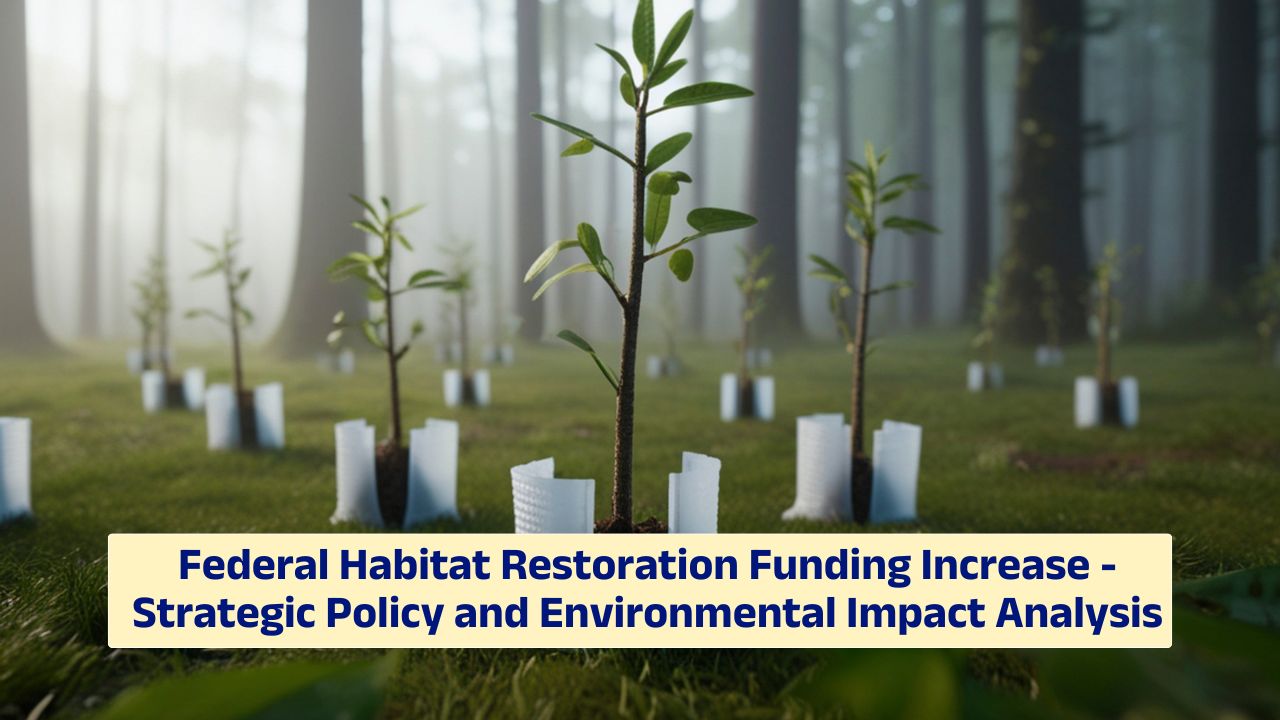
Federal habitat restoration funding has entered a new phase of expansion as public investment in ecosystem recovery gains stronger policy support. Recent budget allocations show a noticeable increase in federal resources directed toward restoring wetlands, forests, coastal zones, and river systems.
The shift reflects a growing recognition that ecological repair is not only an environmental priority but also an economic and climate resilience strategy.
Federal agencies, conservation organizations, and regional governments are now coordinating restoration programs at a scale rarely seen before. Larger grant pools and multi-year funding commitments are allowing long-term restoration projects to move forward with greater certainty.
For communities dependent on fisheries, agriculture, and coastal economies, these investments are beginning to reshape how environmental recovery intersects with economic stability.
| Key Point | Details |
|---|---|
| Funding Growth | Federal restoration budgets have expanded across several environmental programs. |
| Priority Ecosystems | Wetlands, coastal habitats, forests, and river systems are receiving targeted support. |
| Economic Impact | Restoration projects create jobs and stabilize regional industries like fisheries. |
| Climate Strategy | Healthy ecosystems improve carbon storage and climate resilience. |
| Policy Coordination | Multiple federal agencies are aligning restoration programs and grants. |
Funding
Federal habitat restoration funds have grown across several major environmental programs administered by agencies such as the National Oceanic and Atmospheric Administration and the U.S. Fish and Wildlife Service. These programs support projects ranging from wetland reconstruction to river barrier removal.
Recent appropriations have expanded grant opportunities for states, tribes, and nonprofit organizations that implement restoration initiatives on the ground.
According to the National Oceanic and Atmospheric Administration, coastal habitat restoration alone supports thousands of jobs while improving marine ecosystems.
This funding expansion allows restoration programs to move beyond short term interventions. Agencies can now support projects that take years to deliver ecological benefits, including reforestation efforts, watershed rehabilitation, and coastal marsh recovery.
Ecosystems
The increase in funding is being directed toward ecosystems that deliver high ecological and economic value. Wetlands remain a primary focus because they filter water, reduce flood risk, and provide breeding habitat for numerous species.
River restoration programs are also receiving significant attention. Removing obsolete dams and improving fish passage systems helps restore migratory routes for species such as salmon and trout. Healthy rivers also support agriculture and municipal water supplies.
Coastal habitats are another priority area. Mangroves, marshes, and seagrass beds protect shorelines while serving as critical nurseries for marine life. Agencies emphasize that restoring these ecosystems strengthens coastal resilience in the face of stronger storms and sea level rise.
Federal data compiled by the U.S. Fish and Wildlife Service highlights how habitat restoration improves biodiversity outcomes across both terrestrial and aquatic systems.
Economics
Beyond ecological benefits, federal restoration funding is increasingly viewed as an economic development tool. Habitat restoration projects often require engineers, construction workers, environmental scientists, and local contractors.
Studies consistently show that restoration investments generate strong local economic returns. Coastal restoration, for example, supports fisheries, tourism, and recreational industries that depend on healthy ecosystems.
Rural communities benefit particularly from these projects. Many restoration efforts occur in regions where economic diversification is limited. By supporting environmental workforces, federal funding creates employment opportunities while rebuilding natural assets.
This economic dimension has helped attract bipartisan support for restoration initiatives. Policymakers increasingly frame habitat recovery as both environmental protection and infrastructure investment.
Strategy
Federal agencies are now prioritizing landscape-scale restoration strategies rather than isolated projects. Coordinated planning allows restoration work to address entire watersheds or coastal regions instead of fragmented sites.
Collaboration between federal agencies, state governments, tribal authorities, and conservation organizations is central to this approach. Shared data systems and regional planning frameworks help align funding with ecological priorities.
Technology is also playing a growing role. Satellite monitoring, environmental DNA analysis, and advanced hydrological modeling help restoration teams measure ecosystem recovery with greater accuracy.
This strategic shift ensures that funding increases translate into measurable improvements in ecosystem health. Long-term monitoring programs are being integrated into restoration grants to track biodiversity, water quality, and habitat recovery.
Outlook
The noticeable increase in federal habitat restoration funding signals a broader policy shift toward ecosystem resilience. Governments increasingly recognize that degraded landscapes carry economic, environmental, and climate-related costs.
Future funding cycles are likely to continue emphasizing large-scale restoration projects that deliver multiple benefits. These include biodiversity protection, carbon sequestration, flood mitigation, and economic development.
As restoration programs mature, federal agencies will focus on measuring outcomes and improving project efficiency. Transparent reporting and scientific evaluation will help ensure that public investments translate into durable ecological recovery.
With stronger financial support and coordinated policy frameworks, habitat restoration is evolving from a niche environmental effort into a central pillar of national environmental strategy.
FAQs
What is habitat restoration funding
Public funds are used to repair damaged ecosystems.
Which ecosystems receive restoration funds
Wetlands, forests, rivers, and coastal habitats.
Why is federal funding increasing
To support climate resilience and biodiversity.
Do restoration projects create jobs
Yes, they support engineering and local workforces.
Who manages restoration grants
Federal agencies with state and tribal partners.